Reading a COA and MSDS for Oral Care Imports
Buyers ask for "the certificates" as though they were one file. In practice the pack is assembled from documents with different issuers and validity rules.
Documentation is easiest to assemble when it is requested before production. Some records are batch-specific and can only be produced after a batch exists; others are facility-level and have their own validity. Leaving the request until shipping is slower and sometimes impossible.
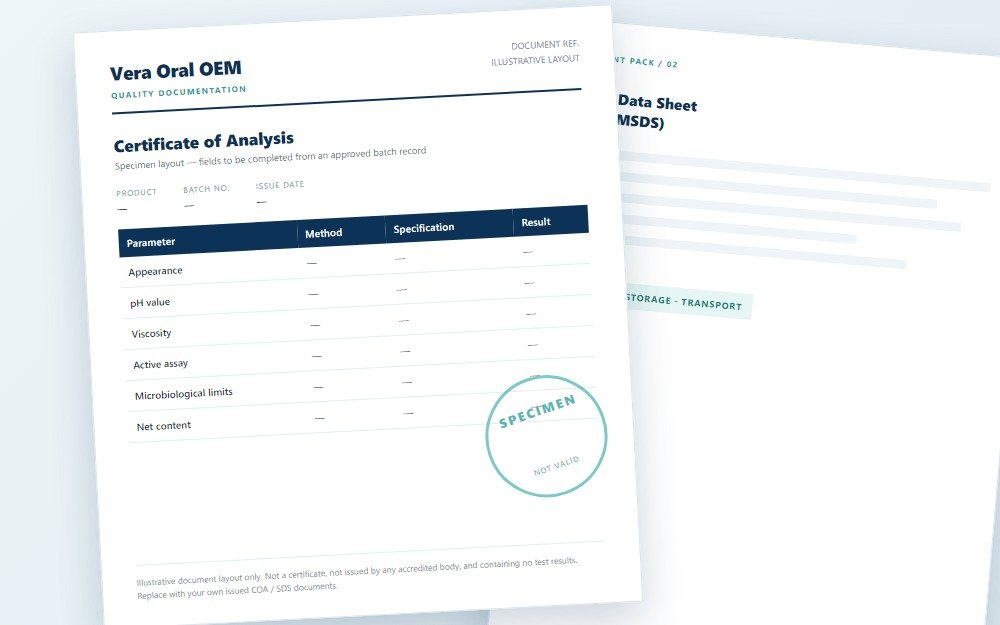
The specimen document shown on this guide's cover is an illustrative layout created for this site. It is not a certificate, contains no test results and is not issued by any accredited body — it is there to show the field structure buyers should expect.
01What each document is for
| Document | What it tells the recipient |
|---|---|
| COA | Batch-specific results against an agreed specification, with method and release statement. |
| MSDS / SDS | Safe handling, composition and hazard communication for transport and storage. |
| Free Sale Certificate | Market-status evidence where the destination authority requires it. |
| Packing list & invoice | Shipment contents, case count, batch and marking references. |
| Facility audit reports | Available GMP / ISO records for the producing facility, checked against current validity. |
02Read a COA as a specification check
A COA is only meaningful against the specification you approved. Check the product and batch identifiers, the parameter list, the test method, the result and acceptance criterion, then the issue date and authorised release. If the parameter list does not map to your written specification, the document is not evidence of conformity to it.
- Product name, batch number and issue date match the shipment.
- Every release parameter in the written specification appears on the COA.
- Test methods and acceptance criteria are stated, not just a pass mark.
- The document is signed or otherwise authorised for release.
03Agree the pack at quotation stage
List the documents your import team, retailer or marketplace will ask for when you request the quotation. Which are batch-specific? Which are facility-level? Who checks certificate validity against current facility records before release? These questions are part of the quality control process, not an afterthought.
For a short answer on what is typically prepared for export, see the export documents FAQ.
04Batch-specific records versus facility-level documents
Mixing the two categories is the fastest way to request the wrong file at the wrong time. Batch records are created after manufacture and describe one production run; facility documents describe the producing site and carry their own scope and validity. Both matter to an importer, but only one of them changes with every shipment.
| Category | What belongs in it |
|---|---|
| Batch-specific | COA against the approved specification, batch record, packing list and invoice for that shipment. |
| Facility-level | Available GMP / ISO audit reports and registrations, checked against current scope and validity. |
| Product-level | SDS/MSDS and, where required, a Certificate of Free Sale for the product and market. |
Ask which of these your importer, retailer or marketplace will actually request, and record the issuer and revision for each. The certificates and audit support page explains how facility documents are described on this site.
05A pre-shipment document handover checklist
Define the handover as a release step with a named owner and a completion record. Reconcile identifiers first, then parameters, then authority and validity. Anything missing at that point should stop the handover, just as an out-of-specification release check would stop a batch.
- Product name, batch number and quantity match the invoice and case marking.
- Every specification parameter appears with method, result and acceptance criterion.
- SDS language and revision suit the transport route and destination.
- Certificate scope, holder and validity are checked against current facility records.
- The recipient confirms receipt of the complete pack before dispatch is closed.
Use the export documents FAQ as the shortlist and the production release gates to place the handover in the schedule.
Questions buyers ask on this topic
Short answers before you write your specification.
Which export documents can be provided?
Documentation is prepared to match the destination market and may include COA, MSDS/SDS, Certificate of Free Sale, packing lists and available GMP / ISO audit reports for the producing facility. Requirements are confirmed before production.
Is a COA the same as an MSDS?
No. A COA reports batch results against an agreed specification; an SDS/MSDS communicates safe handling, composition and hazard information. Importers commonly need both.
Who checks certificate validity before release?
Agree the responsible person in writing at quotation stage. That person checks scope, holder and validity against current facility records for the producing site before release, rather than reusing the copy attached to an earlier shipment. The check is recorded as part of the document handover.
Have a specification to review?
Send your brief and our technical team will come back with feasible options and an approval plan.